| Instructions for Baermann Pan Process |
|
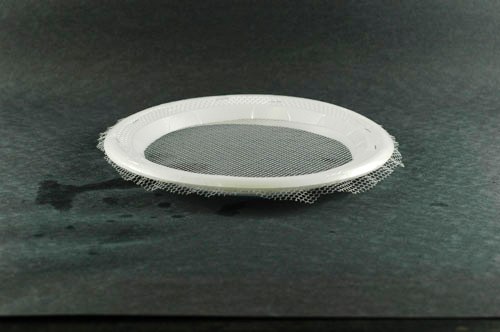
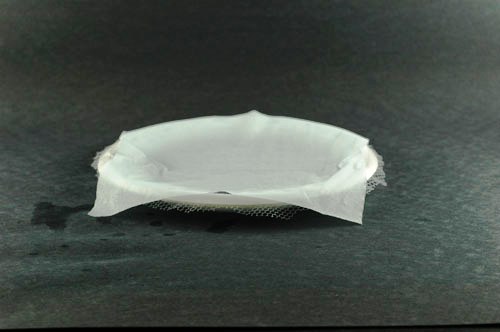
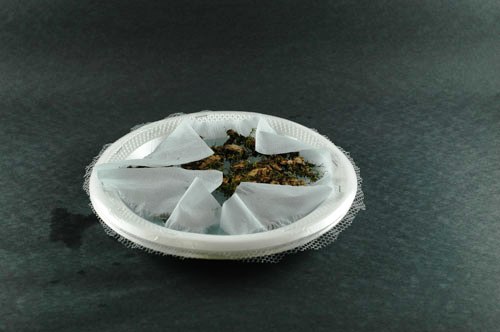
| Place a 1-ply sheet of Kleenex over the dry nylon mesh. [Most
Kleenex is 2-ply, so it is necessary to pull the sheets apart to obtain
1-ply.] |
 |
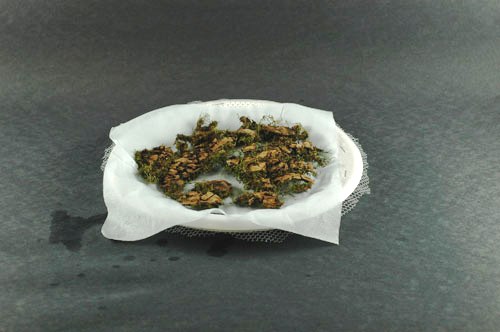
| Arrange mossy bark chips outer face down on top of the dry
Kleenex. If no bark accompanies the moss, I place moss mats with
the outer face up. This is based on the assumption that animals
are more concentrated in the basal portions of the moss mat and will be
more efficiently extracted if the basal region is lying against the
Kleenex. The orientation of the moss may or may not make a
difference and is perhaps something worthy of testing. |
 |
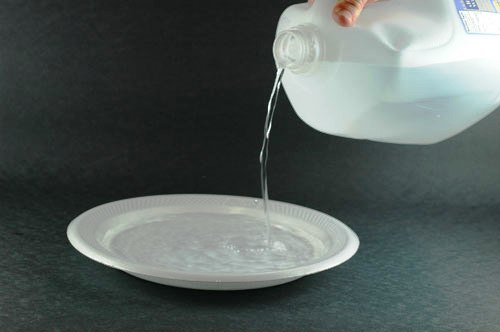
| Place pan where it will remain undisturbed for 24 hours and add
distilled water to 1/2 to 3/4 full. |
 |
| Place loaded mesh into the water-holding pan and gently fold corners
of Kleenex inward (any Kleenex hanging over the rim of the plate will
wick water onto the table surface). You should observe the sample
becoming wet as it absorbs water from the lower pan. |
 |
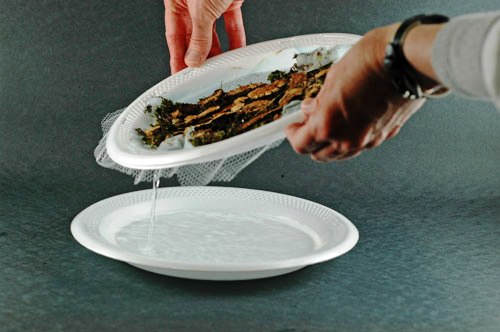
| After 24 hours lift top plate and allow to drain. [Retain the
moss sample plate to run a 2nd extraction. Once the 1st extraction
is complete, return the moss sample plate to a freshly filled
water-holding pan.] |
 |
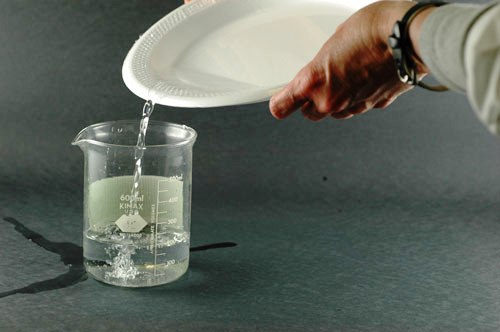
| With two steady hands, carefully raise the water-holding plate and
pour contents into a beaker (600 ml beaker is pictured). Note: the
inexperienced person performing this operation spilled some water.
All of the procedures pictured here, while simple, require some
experience to master. |
 |
| Rinse the pan with a stream of water. This should dislodge any
organisms clinging to the plate. |
 |
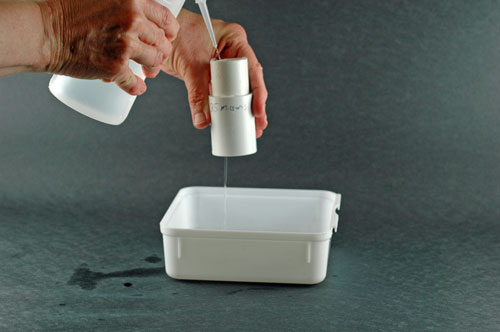
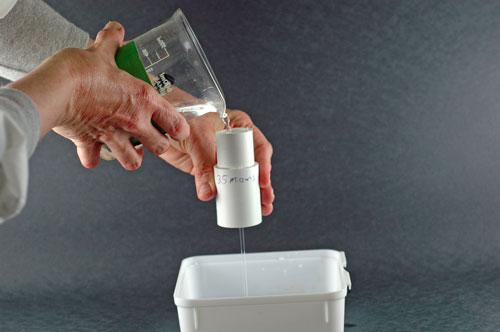
| Pre-wet the dry 35 micron mesh mounted in PVC pipe to ensure water
flows through the unit. This is best done by running tap water
through the unit over a sink. For photo purposes, a stream of
distilled water is used. |
 |
| Carefully pour the contents of the beaker through the 35 micron
mesh. Note that the extract is poured into the narrow end of the
PVC pipe. Swirl the beaker near the end of this operation to
prevent turbellarians and other organisms from adhering to the glass
walls of the beaker. I usually perform this operation over a sink. |
 |
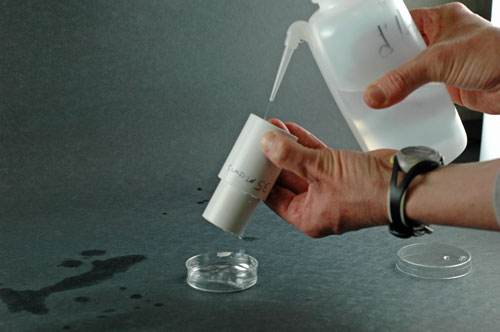
| After most of the extract fluid has drained from the PVC pipe,
invert the PVC pipe over a small Petri dish and backwash the mesh with a
stream of distilled water. Organisms will be concentrated in the
Petri dish within a very clean extract (i.e. free of most obscuring
particulate matter and with virtually no cloudiness to the water).
Observe the concentrated life immediately with a dissecting microscope. |
 |
| Extracts processed this way can be left in a covered Petri dish at
room conditions for weeks, and many organisms will remain active during
this time. |
|